SaaS renewal management is the process of deciding whether to renew, reduce, renegotiate or end a software subscription before its contractual decision deadline. It connects the subscription inventory, the agreement, the business owner and the budget. A calendar alone isn't enough because the cancellation notice date can arrive well before the renewal date.
For a growing company, the most expensive renewal mistake is often a missed decision rather than a poor negotiation. Finance may see the payment, IT may know the application owner, and the department may know whether the product is still useful. None of those views alone shows the contract's notice requirement. A workable renewal process gives one person responsibility for combining them and recording the outcome. That's the whole job, and it's smaller than it sounds.
- Track the renewal date and the last notice date as separate fields.
- Assign a business owner and a budget approver to each contract.
- Start high-value reviews before the contractual decision window closes.
- Compare actual usage, current cost, alternatives and migration risk.
- Record the approved action and confirm it against the next invoice.
What is SaaS renewal management?
SaaS renewal management is a repeatable workflow for reviewing software contracts before their renewal or termination deadlines. It starts with an accurate inventory of subscriptions and ends when the vendor has accepted the change, the service continues under approved terms or the account is closed safely. The middle is a decision process involving finance, IT, procurement and the people who use the software.
A renewal isn't the same as an invoice. An invoice records a charge; the agreement determines what can be changed and when. A subscription might bill monthly under a contract that commits the buyer for a year. It might renew automatically unless the customer gives notice in a specific form. Some vendors allow seat reductions only at the next term. Those differences are why the agreement, not the billing date, should drive the workflow. Here's the test: if you can't find the signed document, you don't know your deadline.
The goal isn't to cancel as much software as possible. It's to pick the right action while you still can. A tool that supports a critical workflow may deserve renewal even when usage is seasonal. The goal is to make an informed choice early enough to exercise the options the agreement provides. That choice should be visible to the owner and the person who controls the budget.
For a small team, a shared ledger and reminders can be enough. A larger company may need automated discovery, integrations and contract workflows. Either way, the underlying controls are the same: accurate dates, an accountable owner, evidence of use, a decision and confirmation from the vendor.
Which dates belong in a SaaS renewal calendar?
A SaaS renewal calendar should store the service renewal date, the contractual notice deadline and the internal review dates separately. The first says when the next term begins. The second says when the customer may lose the option to cancel or change it. Internal review dates are chosen by your team to leave time for evidence, negotiation and approvals.
| Field | Meaning | Where to confirm it | Who owns it |
|---|---|---|---|
| Contract end or renewal date | Date the current term ends or the next term begins | Executed agreement or order form | Procurement or finance |
| Notice deadline | Last date for a valid cancellation or reduction notice | Renewal and termination clause | Contract owner |
| Notice method | Email, portal, named recipient or another required route | Contract language | Contract owner |
| Review kickoff | Internal date to begin evaluation | Team policy based on risk | Application owner |
| Decision deadline | Internal date for approval before notice must be sent | Approval workflow | Budget owner |
| Vendor confirmation | Date the vendor accepted the action | Written confirmation | Procurement or finance |
Don't assume the renewal date is the notice deadline. A hypothetical agreement that renews on December 31 with a 60-day advance notice condition requires action before the renewal date. The exact last valid day depends on the contract's wording, time zone and how notice is delivered. Ask legal or procurement to interpret ambiguous clauses rather than making a universal calendar rule.
Create reminders relative to the notice deadline, not only the renewal date. A 30-day reminder sent before a renewal may already be too late when the agreement requires earlier notice. For high-value contracts, the team can start months ahead. Zylo's published guidance uses a 120/90/60/30-day review sequence as an operational example, not a contractual requirement for every vendor.
A calendar should also show the source of each date. If a contract owner copies a date from an invoice without the signed agreement, label it provisional. That makes the uncertainty visible before the deadline is missed. Save the current agreement and any amendments together, because an amendment can change the renewal period or the allowed notice method.
How do I build a reliable SaaS renewal inventory?
Build a SaaS renewal inventory from finance records, contracts and application-owner confirmation. Start with the tools that create the largest committed costs or have the nearest decision dates. Each record should have a product, legal vendor, business owner, budget owner, contract value, billing unit, renewal date, notice requirement, payment source and evidence link. Don't wait for a perfect inventory. Start with the contracts that renew soonest and you'll close the gaps as you go.
Finance is the best starting point for finding recurring payments, and it's usually where the surprises show up. Card statements, accounts payable records and procurement files expose vendors that IT may not administer. The application owner then explains who uses the tool and whether there is a replacement in progress. They're the people who know what'll break. IT confirms whether access can be transferred or removed safely. Procurement or legal checks the contract clauses.
Keep different cost concepts in separate columns. Monthly cash payment, annualized run rate and total contractual commitment aren't interchangeable. A $500 monthly charge has a $6,000 annualized run rate if it stays unchanged for a full year, but that arithmetic doesn't prove the company is committed to $6,000 or can cancel tomorrow. A contract may also include minimum quantities, setup services or usage overages.
Add a status field that reflects work rather than optimism: evidence missing, review scheduled, awaiting owner, negotiating, approved to renew, approved to reduce, notice sent, vendor confirmed or closed. A contract shouldn't move to completed simply because someone emailed the vendor. Until the vendor answers, you've only asked. The vendor's response and the next invoice determine whether the intended change actually took effect.
Keep a change history, because you'll need it when a date turns out to be wrong. Record who changed a date, which agreement supported it and when the change happened. When an employee leaves, transfer ownership rather than deleting the record. A renewal system with perfect reminders but no responsible person still fails at the decision stage.
What does a practical SaaS renewal process look like?
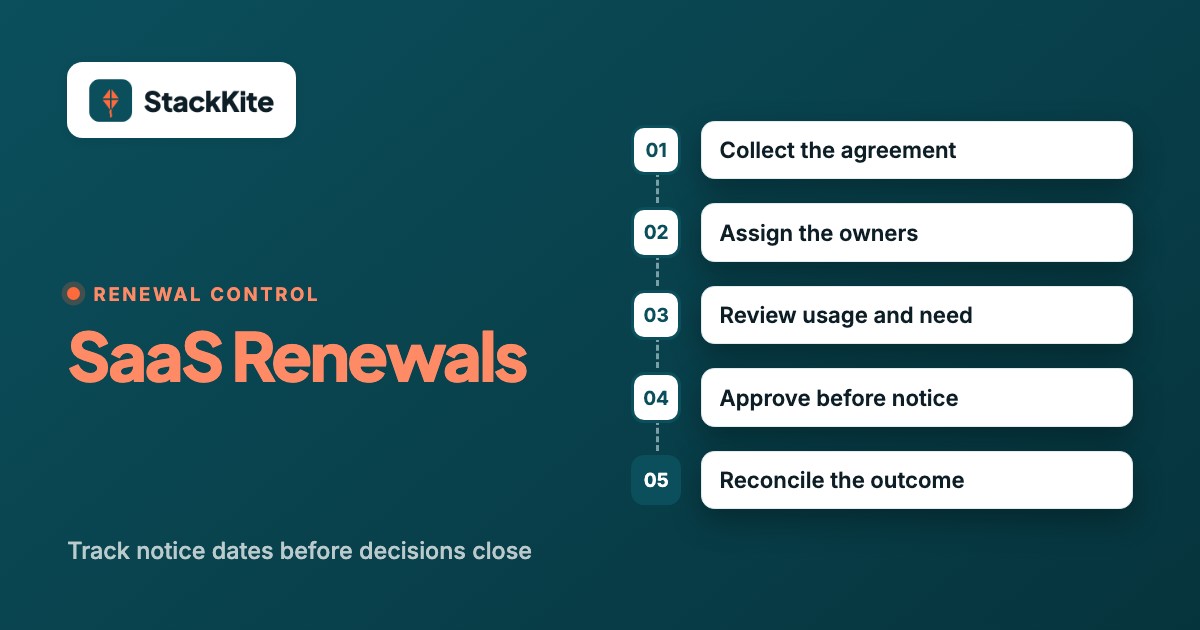
A practical SaaS renewal process begins with the notice deadline, works backward through review and approvals, and ends with commercial confirmation. The steps below are a suggested operating cadence, not a statement about any vendor's legal terms. Compress or expand it based on contract value, migration risk and the real notice window.
Collect the agreement
Attach the signed order and amendments, then record the renewal date, notice deadline and permitted notice method.
Assign the owners
Name a business owner, an IT contact and the person authorized to approve spending.
Review usage and need
Compare purchased capacity, relevant use, business dependency and upcoming changes in headcount.
Calculate the decision options
Document the cost to renew, reduce, replace or cancel, including migration and overlap costs.
Approve before notice
Give the budget owner enough time to decide while the contract still allows a change.
Send and preserve notice
Use the contract's required channel, keep delivery evidence and request written confirmation.
Reconcile the outcome
Update the inventory, verify the next invoice and schedule the next review.
A team may choose a 120-day kickoff for a complex enterprise agreement and a shorter window for a low-risk monthly subscription. The point isn't to copy a fixed number of days. It's to leave a margin for slow approvals, security review and migration while staying ahead of the earliest binding deadline.
Set an escalation rule, since people aren't always quick to answer. If the business owner hasn't replied by the internal decision date, the record should move to a named budget approver. Don't silently interpret a missing reply as permission to cancel a critical system. Equally, don't interpret silence as permission to accept a large price increase without review.
How should I evaluate a subscription before renewal?
Evaluate a SaaS subscription against business value, actual usage, current price, alternatives and the cost of changing tools. These dimensions answer different questions. Usage indicates adoption. Business value indicates whether the application still supports a necessary job. Price determines the financial exposure. Switching cost tells you whether a theoretically cheaper alternative is practical.
Begin with the owner. They'll know what's actually used. Ask which workflows would stop if the product disappeared, who depends on them and what changed since the last renewal. Then inspect the available activity evidence. Some vendors expose last login, others show feature use or active seats. Those measures aren't equivalent, so record the definition and observation window. Who's logged in isn't the same as who's working in the tool. A rarely used compliance tool may still be necessary. Low usage isn't always low value.
Next, compare what was purchased with what's assigned. If the agreement permits reductions, unused or unneeded seats can become negotiation candidates. If the contract is fixed until renewal, reclaiming a seat may avoid a future purchase but may not reduce today's invoice. Keep cost avoidance separate from realized savings.
Finally, compare replacement risk. A cheaper vendor may require migration, employee retraining, parallel subscriptions, integrations and security review. A cost comparison that ignores those costs can make the wrong option look attractive. Document what the organization would lose as well as what it might save.
A decision memo should be short enough to read: current annualized cost, renewal offer, proposed action, rationale, alternatives considered, one-time transition costs, owner, approval and the contractual deadline. Attach detailed evidence instead of burying it in a long narrative. Keep it short; nobody's going to read five pages before a deadline.
How do I calculate the cost of renewing, reducing or switching?
Calculate renewal cost from the actual quote and contract, then model alternative scenarios separately. Don't confuse a published list price with a negotiated enterprise agreement. Taxes, support, implementation and usage-based charges may sit outside the base subscription.
Consider an illustrative design subscription with 40 seats at $30 per seat per month. Its annualized seat cost is 40 × $30 × 12 = $14,400. If the owner confirms that only 30 seats are needed and the vendor allows the reduction at renewal, the new annualized seat cost would be 30 × $30 × 12 = $10,800. The potential difference is $3,600 per year. These are hypothetical numbers, not a benchmark or a guarantee of savings.
Now imagine a competing product costs $25 per seat per month for the same 30 seats. Its annualized subscription would be $9,000, a further $1,800 below the reduced incumbent subscription. But suppose migration, training and parallel access would cost $4,000 in the first year. The first-year switch case would then be $13,000, more than the $10,800 incumbent reduction, although still less than renewing all 40 seats at $14,400. A second-year comparison might differ. The point is to show all relevant cash flows rather than only the cheapest seat price. It's why the cheaper product doesn't automatically win.
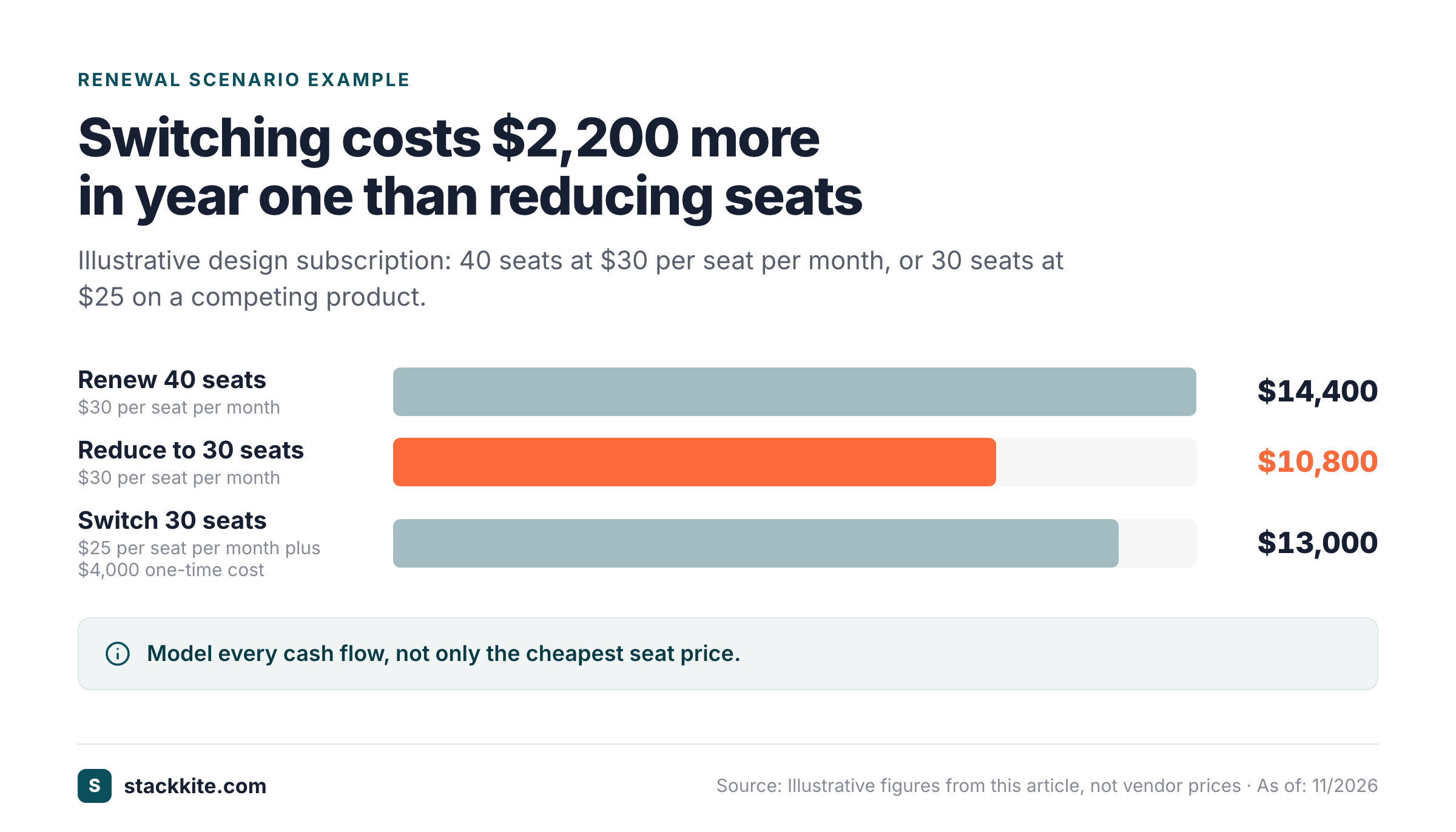
| Scenario | Illustrative recurring annual cost | Illustrative one-time cost | First-year total |
|---|---|---|---|
| Renew 40 seats | $14,400 | $0 | $14,400 |
| Reduce to 30 seats | $10,800 | $0 | $10,800 |
| Switch 30 seats | $9,000 | $4,000 | $13,000 |
The examples above assume constant pricing and no minimum fees. Actual vendor terms can make some scenarios unavailable. A contract that disallows midterm reductions may shift the benefit into a later year. A volume discount may disappear when seats are removed. Ask for a revised order before recording a realized reduction.
What should I negotiate at a SaaS renewal?
Negotiate the terms that determine future cost and flexibility, not only the quoted unit price. A small discount can be less valuable than the right to reduce seats when the team changes. A long commitment can look attractive until the organization needs to consolidate overlapping tools.
Start with the right-sizing request. You'll have more leverage with evidence than with a complaint. Show the vendor the contracted quantity, relevant usage evidence and approved target quantity. Ask for the price at the new volume, including any tier changes. If the vendor refuses reductions, request a shorter term, an agreed adjustment window or credits, but don't assume any of those are available.
Next, inspect automatic renewal language, notice periods and price increase clauses. Ask whether the new order changes the termination method or notice window. A renewal quote should identify the legal entity, products, quantities, service level, billing schedule and effective date. Keep the signed agreement with the inventory record.
Consider support and implementation. If the team needs a dedicated account manager, migration assistance or training, get the scope in writing. If those services are no longer useful, ask whether they can be removed. For usage-priced tools, request the billing unit, threshold and overage calculation so the finance owner can forecast the next year.
Negotiation should follow a business decision. If the team has decided to replace the product, a discount alone may not justify keeping it. If you're replacing the product, don't let a late discount talk you out of it unless the numbers still work. If the application is mission critical, a price concession shouldn't distract from continuity, security or data access. Record the trade-off explicitly.
How do I handle automatic renewals and cancellation notice?
Handle automatic renewals by reading the signed contract, identifying the last valid notice date and sending notice through the required method. Don't rely on a general assumption that cancellation in the billing portal ends an enterprise agreement. Some vendors separate account cancellation from the contractual obligation to pay. If you're not sure whether a portal cancellation counts, assume it doesn't until the contract says it does.
Use a written notice that identifies the customer legal entity, contract or order number, products, effective date and requested action. If the agreement requires notice to a named address or portal, use that channel. Preserve a copy and proof of delivery. Ask the vendor to confirm the effective date and any remaining charges.
If the notice deadline has passed, escalate rather than improvising. Procurement or legal should review the contract, amendments and local law. A missed deadline doesn't automatically prove every invoice is valid, but the team shouldn't promise that cancellation is still available. Keep the commercial dispute separate from technical offboarding until the authorized owner decides what to do.
When the vendor confirms cancellation, plan data export and retention. Identify the people who need records, integrations that depend on the tool and the time required to transfer ownership. A service may stop before the company has retrieved essential information if offboarding is left until the last day. Plan the export while you've still got access.
Who should own SaaS renewals in a small company?
The application owner should recommend the business decision, finance should confirm affordability and commercial impact, and IT should assess access and technical risk. Procurement or legal reviews the contract when the terms are complex. One accountable renewal coordinator makes sure those roles complete their work before the deadline. That's why the coordinator matters: someone's got to chase the late replies.
Avoid assigning every renewal to IT merely because IT administers the accounts. They're not the budget owner. IT may not know whether the sales team still needs a particular feature. Avoid assigning every renewal to finance merely because finance pays the invoice. Finance may not know which integrations would break. They're looking at the invoice, not the workflow. The coordinator should gather both perspectives, not replace them. They're not the decision maker; they're the person who makes sure the decision happens.
Define approval thresholds based on your company's risk appetite. A low-cost monthly tool might need only the application owner and budget owner. A large multi-year agreement may need security, legal and executive approval. The policy should be documented and consistent so people know when to escalate.
For a distributed company, keep the owner and approver in the same record as the deadline. Don't rely on an individual's private calendar. When someone changes jobs, the coordinator should reassign the record and confirm the new owner has access to the agreement.
How can I prevent shadow SaaS renewals?
Prevent shadow SaaS renewals by reconciling software charges with the approved inventory and asking department owners to confirm subscriptions they purchased directly. Card payments, reimbursement claims and team-level purchases can bypass the central procurement process. A renewal calendar that contains only IT-approved applications will miss them.
Review recurring charges by merchant and billing cadence. A vendor may appear under a parent-company name or a payment processor, so the finance owner should verify ambiguous charges before creating duplicates. Link each charge to an application record, a contract or a documented one-time exception.
Add a lightweight purchase intake rule. When a team starts a new paid tool, it should record the owner, cost, renewal date and notice terms at purchase. That's cheaper than reconstructing the agreement when the first renewal approaches. It also helps avoid duplicate tools in different departments.
Don't treat an unknown subscription as an automatic cancellation candidate. Confirm who bought it, what data it holds and whether it supports a necessary workflow. The review can then produce an informed decision rather than an accidental outage. Teams buy tools because they're useful, not to hide them, so treat it as a cleanup, not an investigation.
Which SaaS renewal KPIs should I report?
Report a small set of renewal metrics that show whether decisions happen before deadlines and whether the recorded savings become real. Useful measures include the share of contracts with verified notice dates, the share with named owners, decisions completed before notice, upcoming committed spend and confirmed cost reductions.
| Metric | Definition | Why it matters |
|---|---|---|
| Notice-date coverage | Contracts with verified notice dates divided by contracts requiring notice | Shows the quality of the contract register |
| Owner coverage | Paid subscriptions with a named active owner divided by all paid subscriptions | Finds orphaned renewals |
| On-time decision rate | Renewals decided before their internal deadline divided by renewals reviewed | Shows whether the workflow is early enough |
| Renewal exposure | Contracted spend associated with upcoming decisions | Helps finance prioritize work |
| Realized reduction | Accepted lower commitment reflected in contract or invoice | Separates confirmed results from forecasts |
Keep definitions stable, or you'll be arguing about the numbers instead of the renewals. A contract with an unknown notice date shouldn't be counted as having a safe deadline. A subscription with a former employee as owner shouldn't count as owned. A negotiated discount shouldn't be counted as realized until the agreement and billing reflect it.
Use the metrics to improve the process. Pick the few you'll actually review, because a dashboard nobody opens isn't a control. If decisions are late, move the kickoff earlier or shorten the approval chain. If owner coverage is poor, make ownership a required part of new software intake. If potential savings rarely become realized reductions, investigate vendor minimums and contract terms.
What should a SaaS renewal checklist include?
A SaaS renewal checklist should capture the agreement, decision options, approval, vendor notice and final invoice. The following items work as a review control for subscriptions with different billing models. Each item should have a person and evidence, not just a tick mark.
- Attach the signed contract and all current amendments.
- Verify the renewal date, notice deadline and notice method.
- Assign a business owner, technical owner and budget approver.
- Reconcile the invoice, billing unit and contractual commitment.
- Review seats, activity, business need and replacement risk.
- Calculate renew, reduce, switch and cancel scenarios.
- Record the approved action before the contractual notice deadline.
- Send any required notice and preserve delivery evidence.
- Obtain written vendor confirmation of the effective terms.
- Check the next invoice and schedule the following review.
A checklist is useful only when its evidence can be found later. If it's not attached, it didn't happen. Store the signed order, decision memo, notice and confirmation with the subscription record. When a step isn't applicable, record why. When the vendor hasn't responded, keep the action open. Closed means confirmed, not sent.
For the wider portfolio context, see the SaaS spend management guide, the SaaS spend audit checklist and the SaaS license management guide. Those pages address the inventory and entitlement work that makes renewal decisions credible.
Which tools can help with SaaS renewal management?
A spreadsheet can manage renewals when it includes the contract, notice date, owner and a reliable reminder process. It's less useful when teams need shared approvals, an audit trail or many recurring decision deadlines. Choose the simplest system that can preserve the evidence and alert the right person in time. If you're tracking a handful of contracts, a spreadsheet's fine.
Dedicated SaaS management platforms such as  Zylo and
 Torii may offer broader renewal workflows and application visibility. Compare their current contracts and integrations against your actual environment. A feature list alone doesn't prove a vendor can reach every SaaS application or automatically reduce your bill.
StackKite focuses on manual or CSV-based inventory, subscription costs, purchased and active seats, renewal dates and notice deadlines. The current Team plan is $19 per month per workspace, at the time of writing. It includes reminders and an exportable record. It doesn't discover subscriptions automatically, collect usage from vendor APIs or cancel contracts for the customer. The owner still needs to enter or import accurate information and take the action.
If your main problem is missed deadlines and scattered contracts, a maintained inventory with clear ownership may solve it. If your main problem is discovering hundreds of applications and collecting usage from many systems, evaluate a more connected platform and verify its actual supported integrations. In both cases, the renewal decision remains a human responsibility.
Frequently asked questions about SaaS renewal management
The most common renewal mistakes involve confusing billing dates with notice dates, treating inactive seats as immediate savings and assuming a cancellation request is final. The answers below cover the operating rules.
What is SaaS renewal management?
SaaS renewal management is the process of reviewing software agreements and deciding whether to renew, reduce, renegotiate or cancel before the relevant contract deadline.
How early should I start a SaaS renewal review?
Start early enough to gather evidence and complete approvals before the notice deadline. A 120/90/60/30-day sequence is one suggested process, not a universal contract rule.
Is the SaaS renewal date the cancellation deadline?
Not necessarily. The contract may require advance notice, so track the notice deadline separately and confirm the required delivery method.
Can unused SaaS seats be canceled immediately?
Only if the vendor agreement allows the quantity to change. Reclaimed access does not necessarily reduce the current invoice.
What should a renewal calendar contain?
Record the contract, renewal date, notice deadline, notice method, owner, budget, decision status and evidence of vendor confirmation.
A good renewal program makes decisions before they become emergencies. Keep the source contract visible, the owner accountable and the financial outcome verifiable. That's how a calendar becomes a spending control rather than another list of dates.